Nature loss is emerging as a growing business risk. Data from S&P Global shows that 85% of companies in the S&P Global 1200 index have a significant dependency on nature for their direct operations. A vast majority of the world’s largest public companies rely significantly on ecosystem services like water purification, pollination, and climate regulation, yet most companies do not have the supplier data to know where their exposure is greatest.
Pure Strategies finds that most companies have strong starting points for nature. The most common next step is assessing your company’s interface with key ecosystems. However, doing so without detailed supplier data can feel like a roadblock before the work even begins. Furthermore, waiting for the perfect, raw material or farm-level traceability can cause undue paralysis.
As a result, Pure Strategies completed its own assessment for food and beverage U.S. supply chains to spur nature action, especially for companies that lack the data needed to do their own full-scale nature risk assessment. This work is available to clients to support an initial screen, pinpointing potential priority hotspots so your nature strategy stays targeted and efficient as it evolves.
Quantifying nature risks focusing on where it matters most
This nature risk assessment was completed to support a defensible method for informing strategy development and identifying potential on-the-ground action. The work aligns with the aims to recover nature in the Global Biodversity Framework (GBF) and Pure Strategies’ own strategic framework to Protect, Restore, and Sustainably Manage nature for lasting business benefit. The nature risk assessment also incorporates key approaches such as the Taskforce on Nature-related Financial Disclosures (TNFD) and uses the Science Based Targets Network’s High-Impact Commodity List. We used standard datasets to review water stress, biodiversity degradation, land conversion, and soil degradation.
Since this work was designed to support the broader food sector and especially for businesses without traceability to the farm level, we framed this by “ecoregions.” These scientifically established ecological boundaries, the analysis captures the overlapping environmental factors, biomes, and wildlife habitats that dictate true ecosystem health.
The results of this assessment point to each commodity’s priority ecoregion based on nature risk in the U.S. This includes composite “hotspot scores” combine risk category scores into a single measure of overall nature risk in these regions. Teams can still disaggregate the data to see which specific risk categories drive the composite score.
Turning hotspot insights into planet-forward action
To illustrate, consider a dairy manufacturer sourcing alfalfa for cattle feed. Rather than a sweeping, high-cost traceability study across every sourcing location in the U.S., our work identified specific agriculture-dense and high-risk ecoregions, parsing their drivers by risk category. For instance, the Central-Southern U.S. Mixed Grasslands ecoregion is one of the alfalfa-producing ecoregions in the nation. It spans parts of Nebraska, Kansas, Oklahoma, and Texas. Even without farm-level supply chain visibility, it is probable that a company’s alfalfa footprint touches this region.
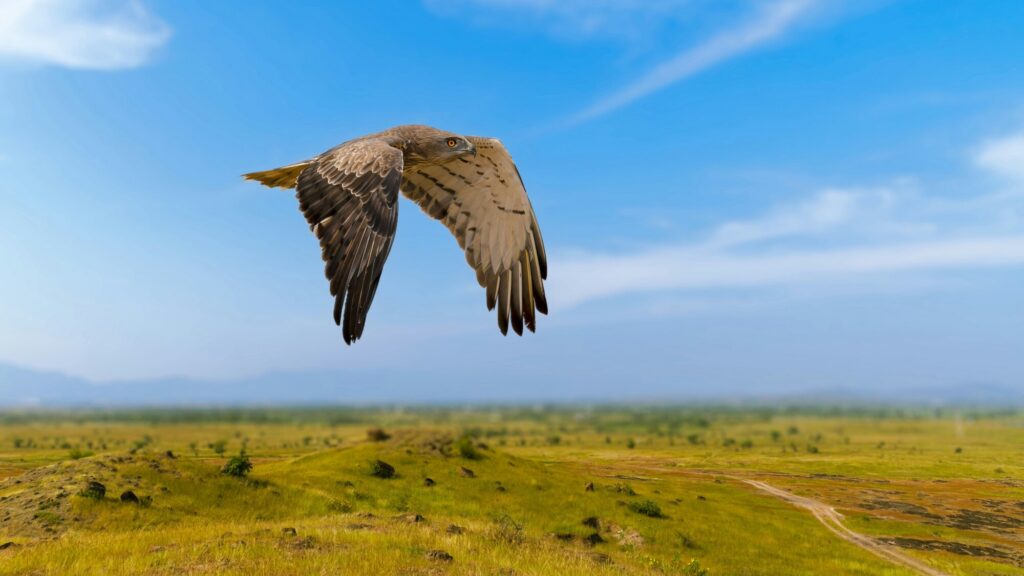
When screened through our nature risk assessment, this ecoregion reveals one of the highest composite nature risk scores in our assessment of the U.S., driven primarily by biodiversity degradation. Addressing biodiversity risks and pressures in this area is critical for ensuring supply chain resilience. In addition, this ecoregion houses an ecologically vital population of native birds, including critical raptor species, meaning taking action can lead to benefits beyond just ensuring agricultural supply.
When specific risk drivers such as these are exposed, sustainability teams can deploy Pure Strategies’ core action framework (protect, restore, and sustainably manage) to guide solutions matched to their level of supply chain influence:
- Protect: For companies without direct supplier influence, partner with regional nongovernmental organizations (NGOs) and conservation groups to safeguard remaining native grassland habitats, preserving breeding and nesting grounds for migratory and resident bird species across the ecoregion.
- Restore: Also, for companies without direct supplier influence, fund habitat restoration projects with those same partners to rebuild degraded ecosystems.
- Sustainably manage: For companies with direct supplier relationships, implement biodiversity-friendly management on active croplands, such as maintaining unharvested crop strips during mowing to preserve prey availability for hunting raptors. Active raptor populations act as continuous, natural pest control. They significantly suppress rodent populations that otherwise destroy crops, chew irrigation lines, or spoil stored grain.
Ultimately, waiting for complete supply chain traceability should not stall your progress. By leveraging ecoregion-level risk insights, food and beverage brands sourcing from the U.S. can move past analytical paralysis and transition from risk assessment to defensible action that benefits both business and planet longevity.