- Two-thirds of companies see climate and nature as business risks, yet many still tackle climate and nature separately.
- Investors, regulators, and standards bodies are raising climate and nature expectations at the same time.
- Nestlé and Kenvue show that an integrated approach can reduce risk, build resilience, and drive growth.
Two-thirds of the largest companies recognize climate change as a risk to their business. Further, 64% of companies and financial institutions surveyed by the Taskforce on Nature-related Financial Disclosures (TNFD) view nature-related issues as at least as significant as climate to their future business prospects. Yet many companies are building the business case and making progress on each one separately, arguably hindering the needed progress.
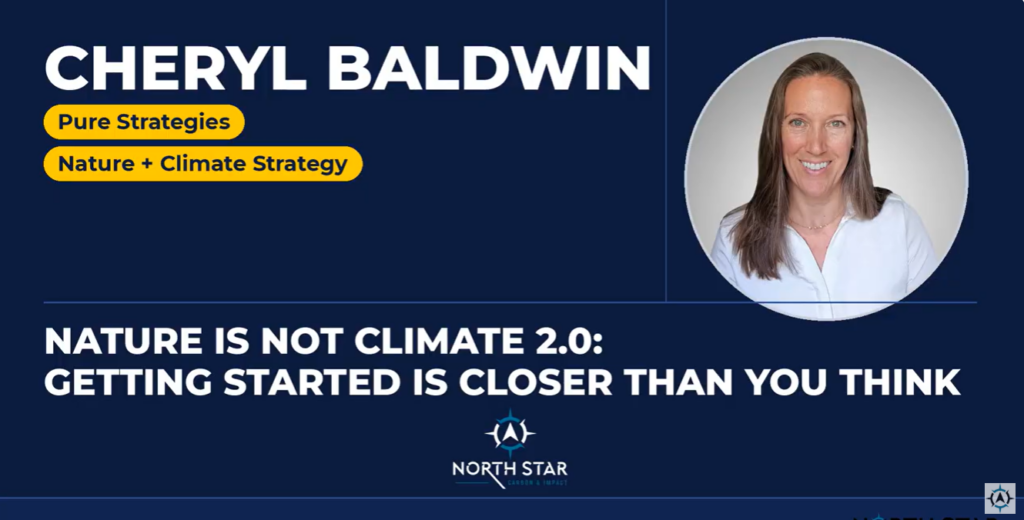
Companies are starting to look at climate and nature at the same time. That message came through at a panel I facilitated at the Pure Strategies New York Climate Week Day of Action event on September 23, 2026, where sustainability leaders discussed what the business case looks like when a company has to manage both at once.
Why both, and why now
Pressure on climate and nature is arriving at the same time across several drivers. The United Nations (UN) Paris Agreement set out the aim of net-zero emissions by 2050, and the Global Biodiversity Framework aims for nature recovery by 2050. Investors are expecting businesses to address these material issues. More than 600 investors have signed on to Climate Action 100+, and more than 240 investors have joined Nature Action 100.
Regulation is moving in the same direction. California’s Climate-Related Financial Risk Act (SB 261) is ready to require large companies doing business in the state to disclose their climate-related financial risk and the measures they are taking to reduce and adapt to it. Climate’s impact on water availability is often part of this work. Further, effective mitigation and adaptation depend on the water, soil, and ecosystems that supply chains rely on, which brings nature into the climate risk conversation. While enforcement of the SB 261 reporting deadline has paused while a court challenge proceeds, many companies are preparing for the required disclosures (as of the writing of this, over 180 companies have filed a voluntary disclosure with CARB).
In the European Union (EU), the Corporate Sustainability Reporting Directive (CSRD) and the EU Deforestation Regulation (EUDR) are also driving disclosure and due diligence conversations. Adding to this, the Land Sector and Removals Standard from the GHG Protocol and the Forest Land and Agriculture (FLAG) guidance from the Science Based Targets initiative (SBTi) now include nature and climate expectations.
Businesses bringing them together
The need for action on climate and nature is clear, and at the same time. The panelists described that they are now shifting from separate climate and nature approaches to a combined effort, and one that includes communities and other core business priorities.
Notably, Nestlé’s updated net zero plan, Roots of Net Zero, illustrates this path:
“For the last five years, since the launch of the net zero roadmap, we have primarily focused on reducing our GHG impact, which in turn has helped to increase the resilience of our business and value chain. Our actions have also delivered benefits beyond carbon, such as to people and nature where we operate. As the next step, we now seek to leverage our net zero roadmap journey learnings and look to evolve towards actions and projects that help to continue to deliver emissions reductions, and address the environmental and social causal factors at play – in our Roots of Net Zero: Nestlé’s Climate and Nature Strategy and Transition Plan.”
To build this integrated climate and nature approach, Nestlé completed its dependencies, impacts, risks and opportunities (DIRO) assessment to understand where the value chain depends on the resources provided by climate, nature, and people.
- Climate: Assessed with TCFD and SBTi to uncover how transition and physical risks affect commodities and operations.
- Nature: Followed SBTN and TNFD to identify impacts and the State of Nature related to water, land, and biodiversity (e.g., biodiversity-sensitive areas) at the crop and location level.
- People: Completed human rights due diligence with the United Nations Guiding Principles on Business and Human Rights (UNGPs) to determine risks across ingredients, countries, and suppliers.
This assessment led to a combination of aims that are interconnected:
- Climate: Net zero by 2050 from the 2018 baseline.
- Nature: Conserve and enhance ecosystem services.
- People: Promote a just transition for people and communities.
Examples of how this integrated plan looks in practice include agroforestry and silvopasture in the supply chain. These efforts have proven to support climate mitigation and adaptation, along with protecting biodiversity and water systems while at the same time supporting farming communities. In addition, Nestlé has a Global Restoration Program (GRP) that supports the reforestation and restoration of degraded ecosystems in their supply chain and sourcing landscapes. This includes planning and growing 80-85 million trees by 2030, contributing to biodiversity, livelihoods, water security and carbon removals.
The company points to business value from these efforts, such as better yields and greater resilience in the supply chain. Nestlé states, for example, that, “Resilience is about the ability of our operations and supply chain partners to withstand, adapt to and recover from shocks caused by extreme weather linked to climate change and poor agroclimatic conditions. These impacts lead to the degradation of natural capital, soils can become depleted, pollinators such as bees can be reduced and water resources can become stressed. This combination of climate volatility and natural capital degradation leads to volatile markets and, in turn, broader societal impacts such as rising living costs and loss of income.”
Kenvue, the parent of brands such as Neutrogena and Zyrtec (among others), also took steps to combine climate and nature. In Kenvue’s 2025 Healthy Lives Mission Report, they state that, “By integrating these topics as part of our Healthy Lives Mission strategy, we aim to build resilience toward risk while supporting the health of ecosystems and communities worldwide.” This is being done by merging climate, nature, water, and manufacturing effluent programs into integrated sustainability action plans for its sites, and adding human rights considerations to those plans, driving to greater business continuity and surety of supply as discussed during our panel.
Where to start
For companies ready to get more from their separate efforts by combining climate and nature with other material topics:
- Assess climate and nature risks together. Combine assessment efforts so interconnected risks are uncovered, and your business can understand the full picture – review Pure Strategies’ Planet Forward Playbook to learn more.
- Prioritize projects with meaningful impact. Start by connecting the dots with existing efforts, e.g., which climate efforts connect to nature, and build nature into climate work where the impact is meaningful – review our Nature Navigator report to get started with this.
- Speak to the business opportunity. Communicate internally how this work brings value to the business, such as continuity of supply for procurement, innovation for R&D, and cost and risk for finance, among other opportunities.
Companies that manage climate and nature at the same time can reduce risk, build resilience, and drive growth. With this in mind, there are compelling reasons to move faster, and the companies on our Climate Week panel showed that it can be done to begin to realize more business opportunity for taking this approach