Now that the Greenhouse Gas Protocol has released the Land Sector and Removals (LSR) Standard and the Science-Based Targets initiative (SBTi) has released the Forest, Land and Agriculture (FLAG) target-setting guidance, companies that source commodities from forests, land, and agricultural systems must ramp up their work to decarbonize their upstream farm and forest impacts. Companies with land-intensive activities across their value chains, including forestry, timber, and food/agriculture production, are required to set FLAG targets. FLAG emissions include emissions that occur before the land-based commodity leaves the “farm/forest gate.” This includes soil emissions from fertilizer application, enteric emissions from livestock, emissions from manure management, and others. The new guidance helps to identify credible investments to reduce farm-level GHG emissions and make forward progress.
As standards change and new guidelines emerge, leading companies, such as Stonyfield Organic, are using the guidance to advance their sustainable agriculture journey, now with industry-aligned tools to claim greenhouse gas (GHG) emissions reductions and removals within land-based systems. The LSR Standard outlines how companies should account for and report GHG emissions and removals from land management, land use change, biogenic products, carbon dioxide removal technologies, and other land-related sources. This deeper level of emissions disaggregation helps to identify where companies should focus carbon mitigation strategies across different commodities, suppliers, and business units.
Driving progress toward FLAG GHG Emissions Targets
Stonyfield has developed an ambitious plan to reduce total corporate emissions across five key pillars: dairy/agriculture, energy, logistics, packaging, and waste. To target and reduce farm-level GHG emissions, Stonyfield enlisted Pure Strategies’ sustainability consulting expertise to clarify how to measure FLAG GHG emissions and drive progress toward its targets. In addition to tracking industrial emissions, Pure Strategies is helping Stonyfield tackle land-based emissions by developing its first FLAG emissions inventory, which separates FLAG from non-FLAG emissions to better understand land-based and other sources.
This work helped pinpoint that approximately half of Stonyfield’s emissions are from FLAG sources—primarily milk and raw ingredients— and half are from non-FLAG sources—transportation, manufacturing, and upstream packaging production. Leveraging this data, Pure Strategies guided Stonyfield through the SBTi target resubmission process to increase its target ambition to align with the 1.5 °C scenario and to include a FLAG-specific target.
Stonyfield now has new climate targets in place and is working to achieve them. The company commits to reducing absolute scope 3 GHG emissions by 30.3 percent by 2030, relative to a 2022 base year. * Stonyfield also commits to no deforestation across its primary deforestation-linked commodities. The company has set a goal to reduce absolute scope 1, 2, and 3 emissions from industrial (non-FLAG) sources by 42 percent by 2030, relative to a 2022 base year. *
SBTi has validated that the science-based GHG emissions reduction targets submitted by Stonyfield conform with SBTi Criteria and the SBTi Forest, Land and Agriculture Guidance. These updated targets and GHG accounting methodology have helped Stonyfield focus efforts across the five key areas of the business and key emissions hotspots. A critical next step to achieve the FLAG component of its GHG reduction target is for Stonyfield to collaborate with its dairy farmers, suppliers, customers, and partners to identify and reduce farm-level emissions associated with milk and dairy sourcing.
A History of Action on Climate Advocacy
Stonyfield acknowledges that the emissions reduction targets are ambitious, but it is up to the challenge. A progressive leader, Stonyfield was among the earliest corporations to take significant action to reduce global GHG emissions. The company has a long history of climate action, from reducing its footprint – offsetting the carbon impact of its facility energy use, to using more sustainable packaging materials (plant-based, lightweight, and all-polyethylene), and setting a science-based target to help prevent global warming from surpassing the 1.5 °C mark, a goal from the Paris Agreement.
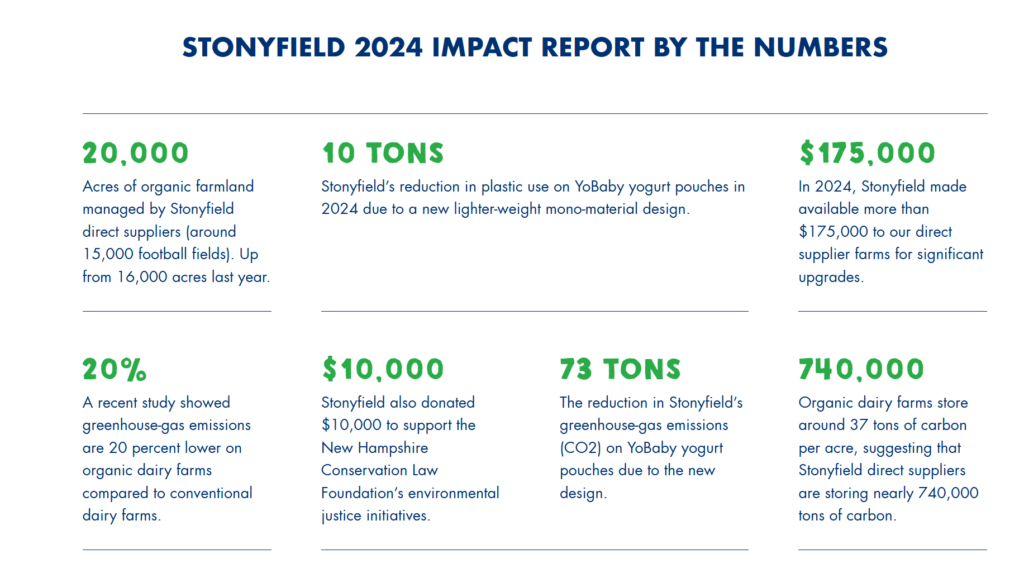
Stonyfield’s latest Impact Report highlights its steadfast commitment to sustainability and social responsibility, particularly within the organic farming and food production industry. The report focuses on Stonyfield’s efforts to promote organic farming practices, reduce its carbon footprint, and support communities through various initiatives.
“With a partnership that spans over 25 years, Pure Strategies helped to assess Stonyfield’s first carbon
footprint, set its first science-based target, calculate its GHG inventory, and track progress,” notes Tim
Greiner, Managing Director, Pure Strategies. “We are now helping Stonyfield tackle land-based
emissions by providing data to inform its FLAG impacts and determining next steps toward meeting its
GHG reduction goals. We look forward to continuing to support Stonyfield on its FLAG journey.”
“With an updated baseline and view of our FLAG emissions, Pure Strategies enabled us to understand
our FLAG impact and inform our GHG reduction strategy,” said Britt Lundgren, Senior Director of
Sustainability and Government Affairs, Stonyfield Organic. “We were able to enhance our science-based target to include FLAG emissions and adjust our level of ambition to a 1.5 °C scenario while identifying new opportunities for carbon removal through improved land management practices.”
*The target boundary includes land-related emissions and removals from bioenergy feedstocks.