A year of weekly questions has come together into one picture of a sustainability program. Since November 2025, we have posted a new question on Wednesday mornings on LinkedIn and on our website, each one a piece of the bigger picture.
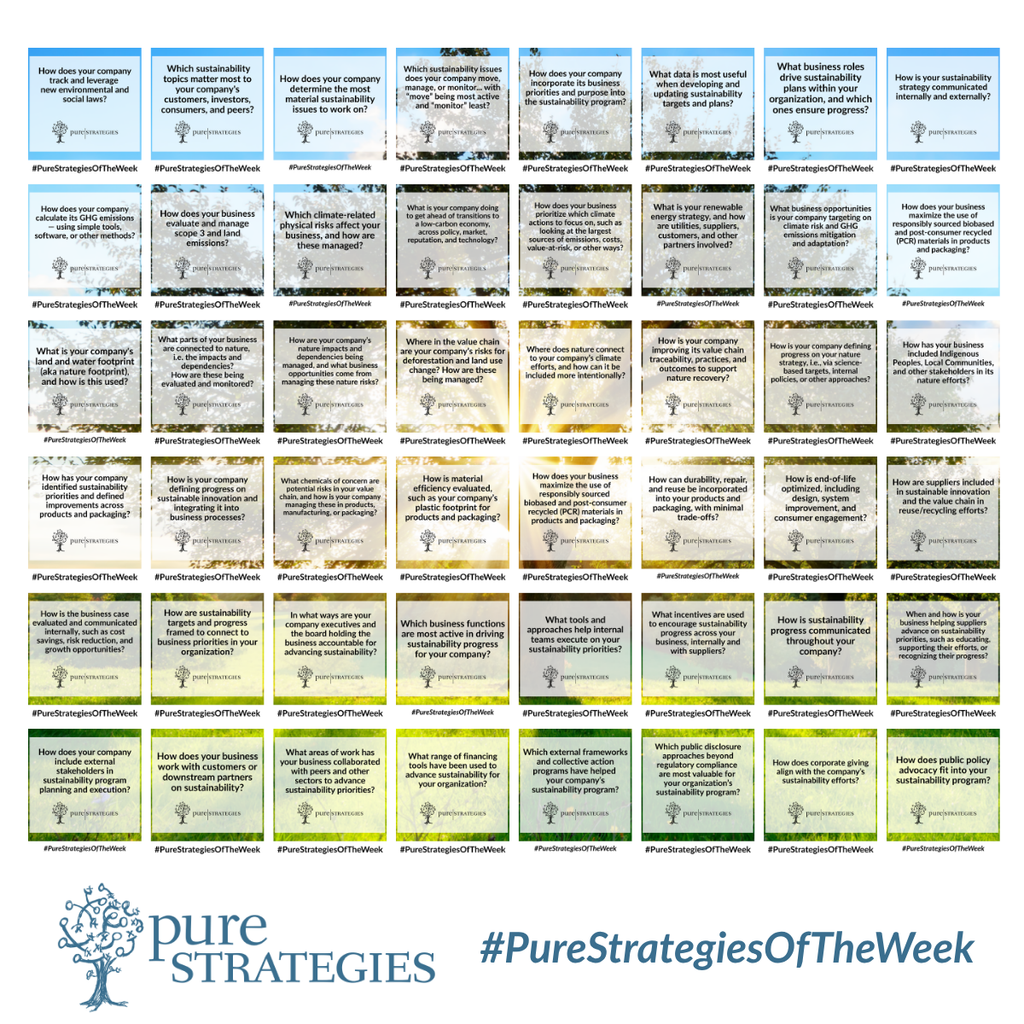
Placed side by side, the pieces form the image shown, and the complete picture shows both where a team can start and how a program fits together.
Fitting the pieces together
A great deal of thought went into our Pure Strategies of the Week campaign. The puzzle has six rows, one for each area of a program: strategy, climate, nature, circularity, integration, and impact. Within each row, the pieces run from earlier steps on the left to later steps on the right, so a team at any stage can find its place.
Reading from top to bottom, the picture is a tree in full sunlight. Strategy is the open sky at the top and sets the direction. Climate, nature, and circularity make up the tree, which is the work a program carries out. Integration and impact make up the ground, which covers how the business builds the practices and partnerships that sustain that work.

Most questions were open-ended, to spark ideas and conversation. Many came with a tip or a link to a tool, to give teams something to act on that week. A few of the pieces show the range of questions:
- Who owns sustainability decisions in your company?
- What’s your biggest Scope 3 blind spot? (Scope 3 emissions are the indirect greenhouse gas emissions across a company’s value chain.)
- Which of your metrics best shows progress toward circularity?
- How do you define sustainability success: impact or intent?
What readers pointed to
The comments that came in tied progress to financial value. Readers described sustainability gaining traction when it costs less and works better, and several named cost and convenience as the test that decides whether people adopt a practice.
That observation matches the business case at the center of our work. Sustainability programs create value through cost savings, risk reduction, and growth opportunities, and companies that share accountability across executives and functional teams tend to gain the most value. The integration questions in the campaign were built around this link, asking how targets connect to business priorities and which incentives move teams to act.
Building the picture
Most programs have gaps, and an unfinished picture shows where they are. The good news is that the sequence runs from earlier steps to later steps, so programs have a way to progress over time. A team still building its greenhouse gas (GHG) inventory starts with the first climate question on how the inventory is calculated and updated. A team with a mature inventory can move to the later questions on how progress is defined, including science-based targets and an internal price on carbon.
From a picture to progress
Use the picture as a tool to support progress with your program. Here are a few ways to turn these questions into action:
- Inventory. Choose one question from each of the six areas where your answer is least certain.
- Strategy. For each question, write down the current answer, the data behind it, and the gap.
- Capacity. Assign an owner and a date and link each action to a business return: cost savings, risk reduction, or growth.
- Collaboration. Bring a supplier, a peer, or an outside partner into the questions that reach beyond your own operations.
With these next steps identified and after seeing the complete picture and all its pieces, where does your company stand?
To discuss this further, contact us! We look forward to hearing where your company stands and ways that we can help move your sustainability program forward.